Forehead Reduction Self-Check List: Should You Get the Surgery or Not?
Not sure if forehead reduction surgery is right for you? This self-check list from YourTime Plastic Surgery covers key measurements, hairline factors, and candidacy criteria.


These days, many patients who come in for forehead consultations have already done a fair amount of self-research and mental preparation — but every so often, someone asks:
"Would it be better for me to get forehead reduction, or should I skip it?"
Whenever that question comes up, I end up giving a rather lengthy explanation. ^^;
Today I'd like to walk through exactly that.
I'm calling it the <Forehead Reduction Self-Check List>.
=======================================================
1. Am I actually stressed about my forehead? (Do I genuinely want to reduce it? / What is my usual hairstyle?)
This is honestly the most important item on the list. It may sound a little contradictory to say that a patient's own motivation matters most when they're asking me whether or not to have surgery — but because cosmetic surgery is not a life-or-death procedure, how much personal benefit you feel you'd gain from it is genuinely critical. So I try to gauge through conversation how much dissatisfaction or stress a patient actually feels about this area. One thing I always ask about is their everyday hairstyle and preferred look.
Even with the same forehead, there is a significant difference in forehead exposure between wearing your hair pulled all the way back in a ponytail versus styling it with thick waves and side-swept bangs.



Many people also have occupational requirements to wear their hair up or pulled back — hotel and other service-industry workers, or those working in food service who must keep hair away from their face. For these individuals, the perceived benefit of the same surgery may differ considerably. Whether or not your wider forehead has genuinely been a source of day-to-day stress or concern for you is the first and most important checkpoint to clarify.
2. The longest vertical distance from the hairline to the upper edge of the center of the eyebrows — 7 cm or more
If you do have real concerns and stress over a wide forehead, the second step is to measure the actual extent of it.
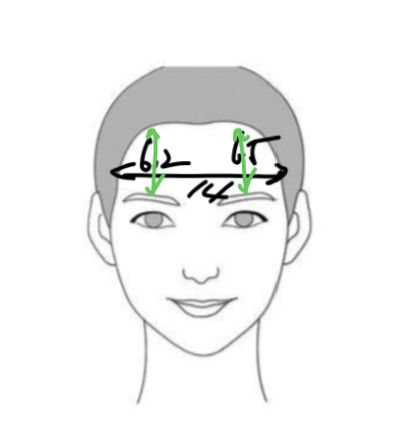
Below is a sample of the measurement chart I actually record during consultations at our clinic.
(Vertical length: 6.2 cm / 6.5 cm; Horizontal width: 14 cm)
I measure the vertical forehead height from the hairline down to the upper edge of the center of the eyebrows, and then measure the horizontal width of the forehead — from the outermost hair-bearing area to the other side (this may vary slightly depending on the density of fine hairline hairs).
If the vertical measurement is 7–7.5 cm or more, I generally tell the patient right away that forehead reduction is advisable. The reason I express a 0.5 cm margin of uncertainty is that this is not an absolute cutoff — it is based on an average Korean woman of roughly 163 cm height and 50 kg.
(Even the same 7 cm looks different on a person with a larger face versus a smaller face; and a 7 cm forehead on a woman over 170 cm tall is perceived differently from the same measurement on someone around 150 cm.)
For men, adding roughly 1 cm gives a comparable reference point (approximately 8–8.5 cm).
In practice, when the measurement exceeds 7.5 cm, a photo immediately conveys very little hair coverage on the forehead — creating a strikingly wide impression.
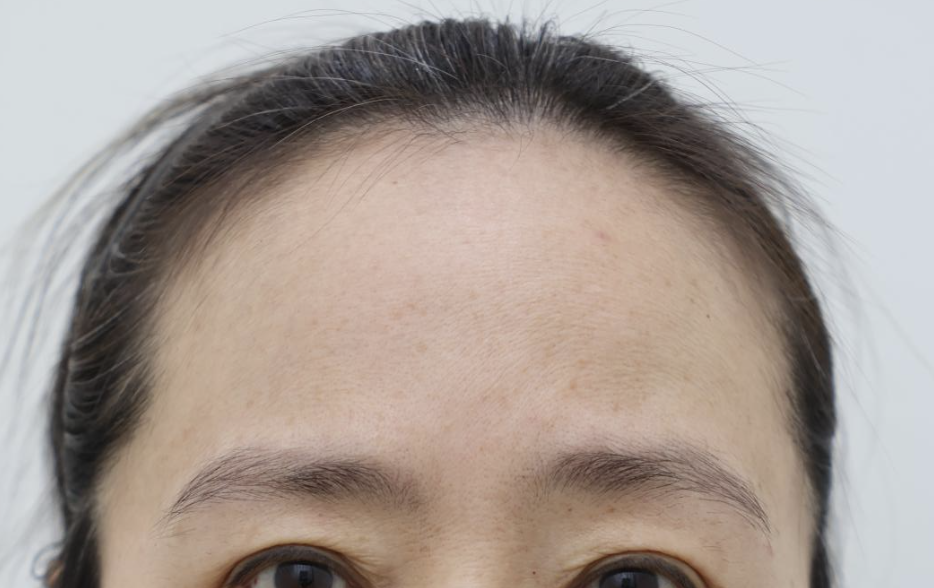
If the measurement is below 7 cm — as in the chart example above — the decision is made through further conversation about the factors mentioned in point 1: usual hairstyle, and the degree of genuine concern or stress caused by the forehead.
3. The horizontal width of the forehead is 2.5 times or more the vertical height checked in point 2 (e.g., if vertical height is 6 cm, horizontal width is 15 cm or more)
When this condition is met, a greater vertical reduction can be achieved with forehead reduction surgery.
Reducing horizontal width, however, is extremely difficult.
Therefore, even if the patient qualifies for forehead reduction and wishes to reduce significantly, if the resulting forehead shape and proportions would be excessively distorted, I may advise against it — or I would strongly recommend combining forehead reduction with a hair transplant procedure.
A quick way to check this yourself is to measure the horizontal width of your forehead. If it is 2.5 times or more the vertical height, I recommend pairing forehead reduction with a hair transplant.
This is because the forehead proportions would otherwise be thrown off — potentially creating a forehead that looks stretched horizontally, like a wide, flat rectangle.


4. A large number of fine hairline hairs within the zone measured in point 2
I have mentioned fine hairline hairs (baby hairs) a few times before.
In reality, what we visually perceive as the hairline is often not the edge of the densely growing hair, but rather the outermost boundary of those fine, thin hairs.
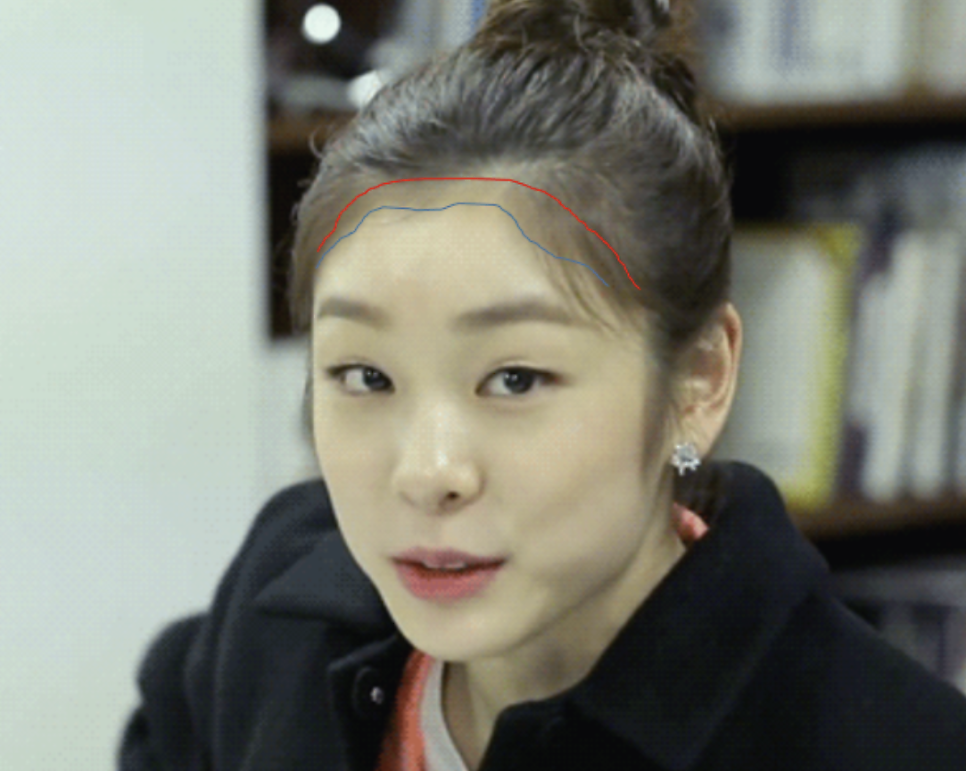
If there are many fine hairs in the skin area that would be excised during forehead reduction surgery, the actual reduction in visible forehead area tends to be less noticeable. This is therefore an important factor to consider when planning forehead reduction.
5. Sparse hair density (thin or thinning hair — consider hair loss treatment)

Forehead reduction surgery cannot make existing hair grow more densely or thicken individual hair follicles.
For this reason, the current quality and density of your hair is an important consideration.
If your hair is already quite sparse, bringing that hairline forward through surgery may not deliver a satisfying result, since the same thin, sparse hair will simply be lowered rather than improved. In such cases, it is important to consider combining hair loss treatment with a hair transplant to address the sparse areas at the same time.
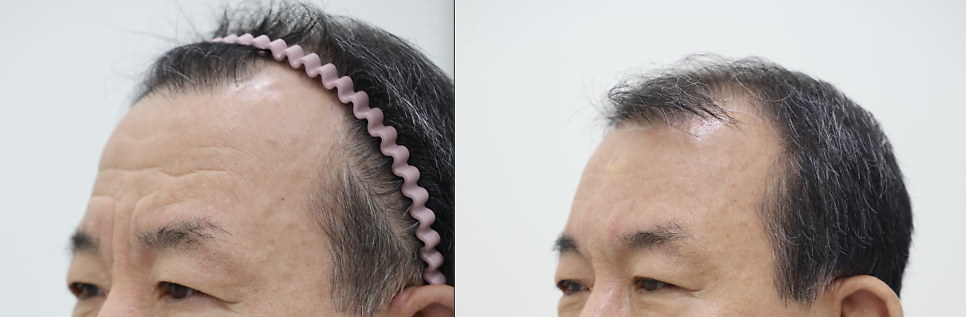
6. Other considerations: irregular hairline shape, brow bone reduction surgery, and sensitivity to scarring
Some patients are more concerned about an uneven, irregular hairline than about overall forehead width — and for those who plan to undergo brow bone reduction surgery and anticipate some skin sagging as a result, forehead reduction may be worth considering even if the forehead is not particularly wide.
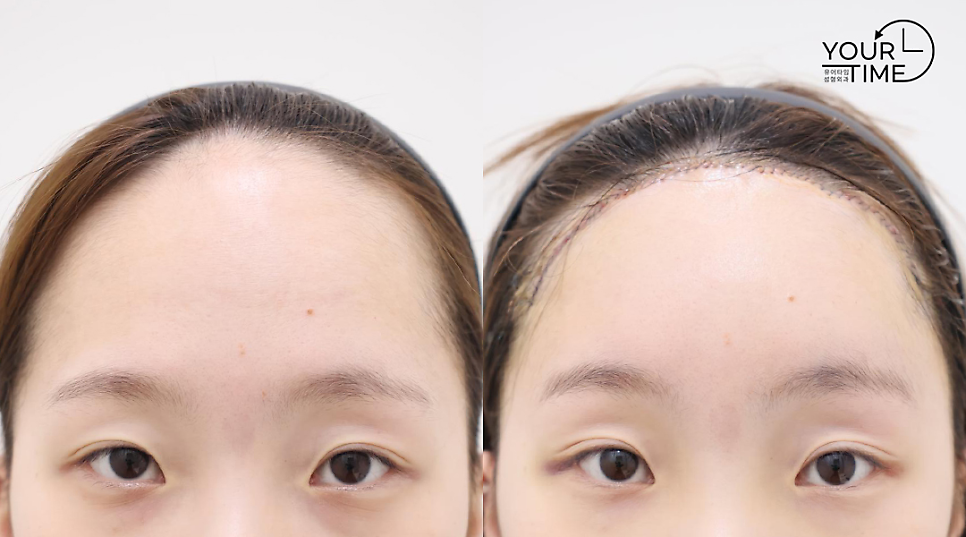
Additionally, for approximately three months after surgery, the hairline scar will be visible and may draw your attention. It is therefore worth reflecting on whether you are sensitive to scarring, or whether you have a keloid-prone skin type.
https://blog.naver.com/yourtimeps/224345060612
< Previous post on brow bone reduction surgery >
=======================================================
Looking back at what I've written, it turned out to be quite a lot of content. ^^;
I hope it is helpful to those of you who are weighing your options.
Next time, I will put together a self-check list for forehead lifting as well — covering who would benefit from that procedure.
**Follow this blog to be notified when the forehead lifting check list is posted!
All new followers are welcome.**
Thank you.
Kwak Chan-yee, Director, YourTime Plastic Surgery